| Quilt History
Today's Quilt Historians Underground Railroad
Women at Work
| New Pathways into Quilt History written by Kimberly Wulfert, www.antiquequiltdating.com
Fine Fabrics in Hard Times
by Joan Kiplinger | | Every so often questions surface regarding the quality of fabrics made during the Great Depression of the 1930s. There is this notion that because times were hard that textiles suffered equally. Thus, when Kim Wulfert presented the idea to research that era, this article was born. As you will see, quality isn’t necessarily affected by catastrophe.
| | Look at the Times The National Scene — Historians and economists, depending on their point of view of economic recovery, give varying time frames for the Depression. 1930 to 1936 seems to be most prevalent with 1938 or 1940 as other ending dates.
Regardless of the time span, those were tough years resulting in widespread hunger, poverty, unemployment and worldwide economic crisis as American capital which had sustained a Europe still recovering from WW1 losses collapsed, causing panic overseas. | Certainly not what economists thought was just a mild bump in the market trying to correct itself. What made it the Great Depression was the breadth and scale of the crisis, affecting this country far more severely than other countries.
Not only from the financial hardships caused by stock manipulations and other industrial and economic factors which created the fall of the market on Oct. 29, 1929 – Black Tuesday -- but also the unwelcome arrival of the Dust Bowl in the Southern Plains [parts of Colorado, Kansas, Oklahoma, Texas and New Mexico] which devastated landowners who were still suffering from the drastic fall of agricultural prices in 1925.
This weather plague would last for eight years, a yellowish-brown wind haze in rolling walls of black. which whipped across the fields raising billowing clouds of dust to the skies. The simplest acts of life — breathing, eating a meal, taking a walk — were no longer simple. | 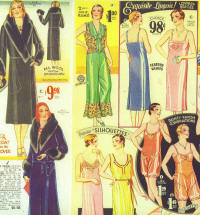
click to enlarge
Depression --
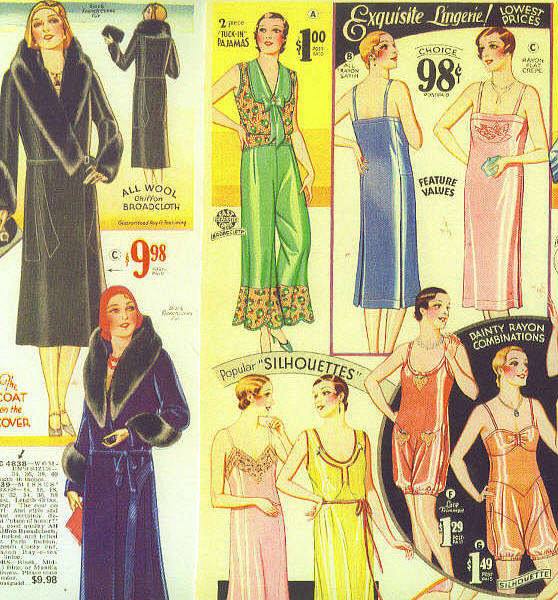
what Depression?? Sumptuous plushes, velours and slinky satins featured in Chicago Mail Order's 1931 catalog would have you believe the world was a carefree and lavish place. There were probably many standing in breadlines in freezing weather who would have loved to be snuggled in one of those coats. | Children wore dust masks to and from school, women hung wet sheets over windows in a futile attempt to stop the dirt, farmers watched helplessly as their crops blew away.
Poor agricultural practices and years of sustained drought caused the Dust Bowl. Plains grasslands had been deeply plowed and planted to wheat. During the years when there was adequate rainfall, the land produced bountiful crops. But as the droughts of the early 1930s deepened, the farmers kept plowing and planting and nothing would grow. The ground cover that held the soil in place was gone. Skies could darken for days, and even the most well-sealed homes would have a thick layer of dust on furniture. In some places the dust would drift like snow, covering entire farmsteads.
There were no government or insurance programs at that time such as there are today. By 1931 local government and direct work programs were proving ineffective; some city workers had not been paid for 8 months. Breadlines, hunger marches, worker protests often turned violent, farm holidays [neighbors refusing to bid on farm auctions and moving evicted tenants furniture back in their foreclosed homes] and Hoovervilles [homeless encampments] were standard occurrences and scenes nationwide.
By 1933 when President Franklin Roosevelt took office, nearly 27% of wage earners, about 8 to 15 million, were unemployed due to firings and layoffs. Most factory workers worked twice as hard to earn the same amount of money they did before the Depression hit. Many lost their lands because they couldn’t keep up their payments – 40% of the farms in Missouri were up for foreclosure. Schools with little budgets to work with, shortened their days and hours.
A wide variety of federally funded programs called the New Deal were instituted to restore the economy and reform the system. These programs included repealing Prohibition, a farm relief bill, a four-day bank holiday to address the banking crisis, financial reform and other programs giving rise to the origins of government alphabet soup -- Civilian Conservation Corps [CCC] for conservation projects including the Dust Bowl; the Tennessee Valley Authority {TVA], which harnessed water power to create energy in the Tennessee River Basin; and the Works Progress Administration [WPA] for drought relief and other work projects employing more than 8.5 persons.
While the Okies, derived from Oklahoma which was hardest hit by the Dust Bowl, traveled westward to the fertile valleys of California, others came in droves from small towns to the large industrial centers and cities to find work. My own parents and relatives were among those hopefuls. And those already living at the poverty level had no idea there was ever a Depression while former millionaire businessmen were reduced to selling apples and pencils on street corners. But there was work and some prosperity, uneven though it was from region to region. People did have money to spend.
By 1936 higher agriculture prices, work programs and, industrial orders were gradually improving the economy. However, while the New Deal did help restore the GNP to its 1929 level, it was only when the federal government imposed rationing, recruited 6 million defense workers, drafted 6 million soldiers and ran massive deficits to fight World War II did the Great Depression finally end.
| The Textile Scene — This industry was still reeling and trying to recover from one of its worst periods of manufacturing from post-WWI through the 1920s. Consumer demand for more and more novelty fabrics [fancier weaves and textures and new color shades] spawned quantity over quality manufacturing so mills could keep up with the non-stop consumption.
American fabrics were a laughing stock worldwide because of their poor workmanship. Textile and trade publications, industry leaders and consumer groups screamed for reforms within the textile industry to set production and worker performance standards. Suffering the most from the uproar were those mills producing high-quality products as they attempted to keep their names reputable.
In the latter 1920s, many smaller mills faltered due to poor management, unfair labor practices and shoddy merchandise. Most were bought up by larger mills which kept some operations and disposed of the rest. Signs of improvement were visible by1930 as the industry began reshaping itself.
Ironically the Depression years were those of remarkable achievements by and for the textile industry including second-generation rayon technology, the Draper Northrop loom for enhancing the weaving of rayon and its improved cotton machinery, the removal of nitrocellular rayon from the marketplace due to its toxic properties, and adherence to the Federal Trade Commission’s Wool Products Labeling Act, to the listing of percentages in silk weighting and to regulations on false and misleading advertising. | 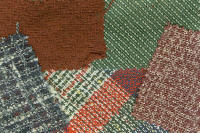
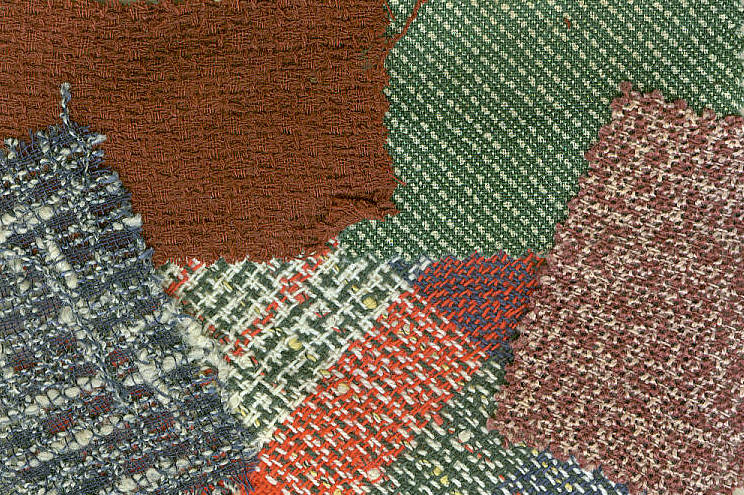
click to enlarge The demand for novelty fabrics from the 1920s carried over into the 1930s. This group of textured fabrics ranging from shadow checks to nubby, crepey and meshy tweeds were popular throughout the 1930s. Difficult to believe they are cotton.
Cotton Textile Institute, 1931.
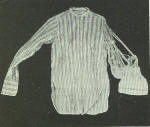
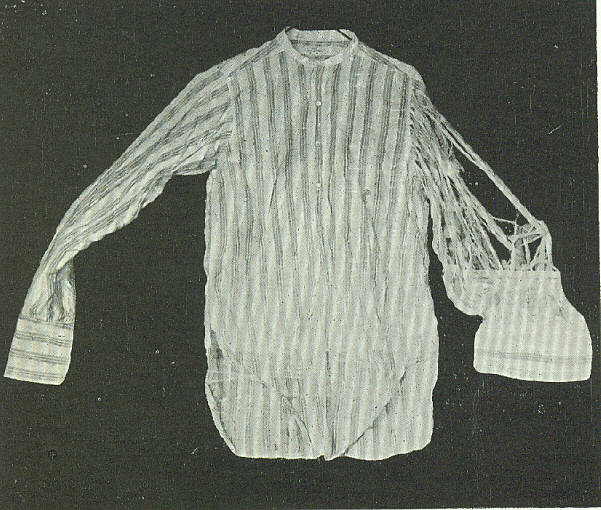
click to enlarge An example of putting rush manufacturing above quality to provide innovative fabric to a demanding public in the 1920s -- this shirt is a cotton warp and rayon filling. Two different bolts of rayon were used, and the rayon from one bolt was unable to withstand ordinary laundering resulting in a shredded sleeve with rayon disappearing. Had proper inspection standards been in force, the rayon differences would have been noticed before weaving and corrected.
Textile Fabrics, 1927 | Many of the mills still practiced paternalism by creating ways to keep employees on the payroll; other mills with little heart were forced to follow government guidelines regarding hours and wages. As the government moved to implement job opportunities during the Depression, one of the provisions in its National [Industrial] Recovery Act [NRA blue eagle] of 1933 was spacing work hours so all employees would have an equal chance to earn wages. This meant enforced limited work weeks and equalizing wage rates regardless of region. Southern pay, previously much lower than elsewhere, for the time being was now equal to northern wages. The NRA was declared unconstitutional in 1936 as it wasn’t benefiting all businesses uniformly.
Thus the textile industry, subject to frequent periods of anxiety due to the ups and downs of the cotton futures market and tariff changes, survived the Depression in better financial condition than many other industries, owing to its essential product.
| Fabrics and Equipment — One only has to browse through swatch books, catalogs, magazines, promotionals and other publications of the 1930s to realize the abundance and variety of textiles for consumers at all levels. It was a decade of two fashion modes with long skirts and sensuous styles for the first half and short skirts and casual styles for the second half. Satins, rough wools, linen, linen-textured cotton and rayon bold crepines called ruff were at the top of the list for women. Linen and wool worsteds were fashionable for men.
Some persons, particularly those who collect quilts and old fabric for restoration but are not familiar with mill operations, discover that their particular piece[s] of cloth from the 1930s or presumably from that time period bleeds, fades and goes limp after washing because it was so heavily sized, that is filled with starches to make fabric appear firmer than it actually was.
They deduce that because these cottons, or any cottons or other fibers for that matter, were made during the Depression they were made from inferior substances with low thread counts under substandard conditions because there was little money to upgrade equipment or hire competent employees, etc.
Those assumptions are not necessarily valid as quality is not confined to any age. While it is a given that not all the fabrics made in the 1930s were quality goods, one can make the same comparisons today in this age of affluence by going to any fabric outlet store or outlet section in a fabric chain and find fabric which crocks, is not colorfast and doesn’t look hardy enough to withstand even one washing. It must be remembered that manufacturers in general produce a range of price- affordable products as a matter of economy and shrewd business sense to attract all consumer levels. | 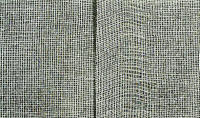
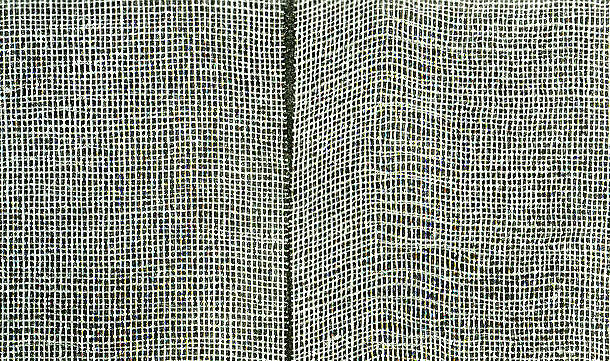
click to enlarge The effects of sizing --left photo shows muslin [slightly magnified] in its finished state on the bolt. It has been sized with various starches which give cloth the appearance of being firmly woven. Right photo shows the collapse of weave structure after the first laundering has washed out sizing. Many cheap fabrics were doctored in this manner to mislead consumers about the quality of a cloth. -
Textile Fabrics, 1927 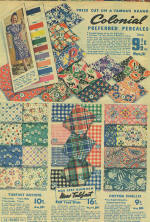
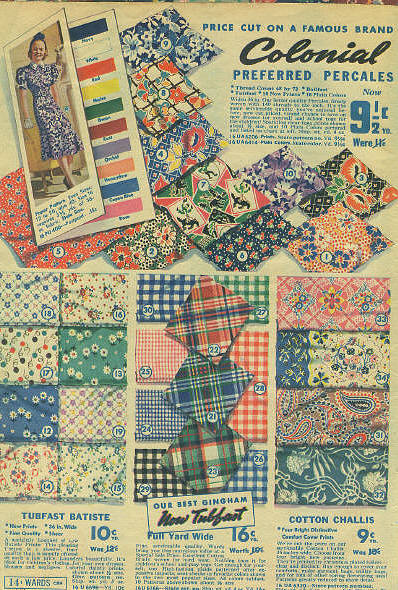
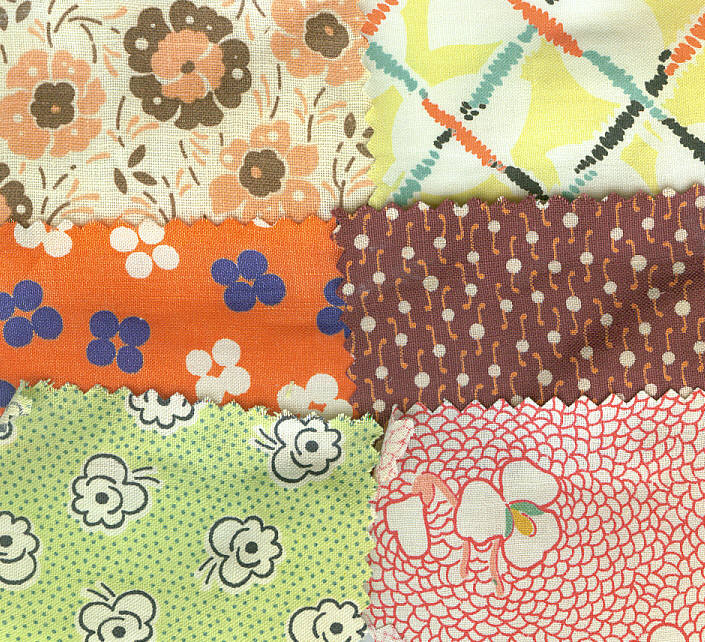
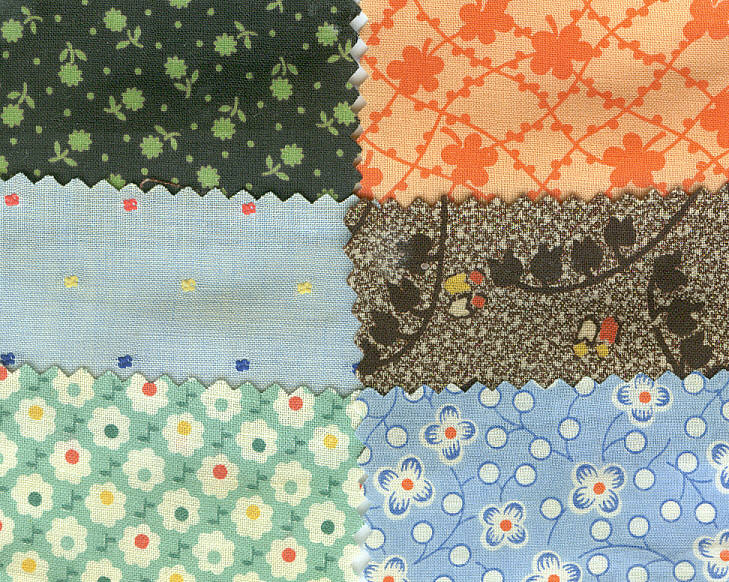
click to enlarge Textile manufacturers, including catalogs which featured their own house brand fabrics, took great pains to draw attention to the reliability of their cloths. Boilfast, colorfast, sunfast and preshrunk in some cases were surefire sellers. Toward the end of the 1930s tubfast began emerging as an umbrella term to replace colorfast and boilfast. - Montgomery Ward 1939 catalog. | | Mills and finishers of the 1930s which produced cloth they were proud to claim as the best were no different than their counterparts today. Quality depends on many things: superior strains which will produce a surface to properly absorb color; modern machinery for processing, spinning and weaving; excellent dyes and inks and the correct equipment to deliver those dyes and print to cloth; modern machinery for other necessary or cosmetic finishing applications and final inspection to insure a flawless operation. All of these factors must be taken into consideration collectively for manufacturing a quality cloth. | | 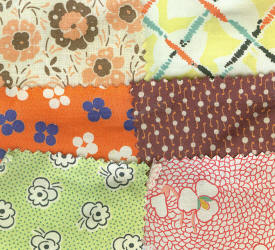 | 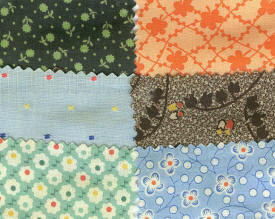 | | click to enlarge | These incredible high thread count cotton swatches shown in the Cotton Textile Institute 1931 fall promotional booklet introduce the colors so characteristic throughout the 1930s. They range from embroidered chambray to broadcloth to sateen to fine plains [superior cottons, usually combed] which are silky and lustrous. Several feel like they could be Sea Island cotton. One would have to find a good specialty fabric store today to obtain cottons of this high quality. | | Modern mills of the 1930s [those which stayed abreast of technology and continually upgraded their equipment] which maintained high-performance operations standards would ensure that not only was the best of dyes used but that other components to get cloth to the dyeing stage and dyeing operation itself were equally top notch. Machine lubricant, automatic temperature controllers, grinders, bleaching kiers [vats] with mechanisms for distributing even circulation and liquid strength; dye gums and bleaching oils, hydrosulphites, purification systems, foaming preventers in the dye box and a host of other ingredients were vital to color perfection. And of course follow that up with printing inks and machinery which have their own specialty entourage.
Perhaps the most vital element because of its visibility to us is dye or color. We think of color in broad terms of a dye put in a vat and then soaking cloth in it. And if the dye is top grade, it will be colorfast and fade proof forever. Of course that is not so. A mill can have the best dyes in the world but if the all the equipment to transfer them to cloth is inferior, then the result is a bum dye job.
We are fortunate that yardage and garments from the 1930s, in fact any decade, are available for use and study. Aside from their colors and pattern, their history of how they were made are just as important and interesting.
The next time you hold a 1930s era cloth that is substandard in some respect, think about what part of the operation might have caused that; could be something as simple as a cranky kier out of kilter. By the same token, pay special attention to the array of 1930s fabrics you might own. The 1930s produced incredibly beautiful textiles which were not equaled until the glamour fabrics of the 1950s. **********
And thus ends the Depression era. With the advent of WWII, technology in many fields
would contribute new fibers and uses which would change the textile industry forever. |
Bibliography:
Joan Kiplinger is an antique doll costumer, vintage fabric collector, researcher and author. She hosts a vintage fabric internet discussion list, writes a monthly vintage fabric column and has been published in several textile magazines. Her book Vintage Fabrics ID and Value Guide 1880-1959 was published in 2005. She welcomes any questions or correspondence and can be contacted at jkip@ncweb.com | * Women (and Men) at Work
© 2006 - 2022 Kimberly Wulfert, PhD. Absolutely no copies, reprints, use of photos or text are permitted for commercial or online use. One personal copy for study purposes is permitted. |
Fabrics & Dyes
Rugs & Textiles
Books & Reviews
Resource Links
Home
| Visit my
online shop ...
for quilt history lovers! * Gifts & Jewelry,
* Books & Stationery,
* Archival Supplies,
* DVDs,
* Quiltmaker Supplies.
| | |